

Executive Summary
VNET Group Inc (“VNET”) has emerged as an increasingly critical component of China’s AI infrastructure buildout, with its “dual-core” strategy combining a retail data center platform and rapidly expanding purpose-built wholesale business positioned to capture accelerating demand for high-density compute capacity.
The emerging opportunity is also underpinning an aggressive investment cycle, which management characterizes as proactive procurement of critical infrastructure to preserve flexibility for future capacity expansion and capitalization of rising AI demand. By the end of 2Q26, VNET had secured more than 3.5GW of total capacity in the Chinese mainland, alongside approximately 500MW overseas. Management has earmarked RMB 10-12 billion of planned capex to support 450-500MW of incremental capacity deliveries this year, broadly flat with 2025 spending but about 3x 2024 levels and exceeding the preceding three years combined. Considering VNET’s accelerating capacity expansion efforts, the quality of its underlying assets, property rights and capital allocation becomes increasingly critical to gauging the durability of prospective AI returns.
However, my investigation into VNET’s historical and current property disclosures has identified three unresolved issues spanning more than a decade:
1. VNET repeatedly classified its Ningbo data center as part of its “self-owned” footprint for years before later disclosing the facility had been subject to a third-party lease dating back to approximately 2010;
2. The company has identified prolonged challenges in obtaining land use right and property ownership certificates for certain data centers located on state-owned land; and
3. VNET continues to acknowledge incomplete verification of certain lessors’ ownership of, or legal authority to lease, properties occupied by the company.
While each of these issues could be viewed independently, when taken together they converge on a common concern over the completeness, reliability and accuracy of financial reporting associated with VNET’s property rights – and by extension, its operating footprint and relevant earnings. These weaknesses are also becoming increasingly consequential as VNET’s investment cycle expands, raising the materiality of associated assets and liabilities. Any underlying control deficiencies would increase the risk of material misstatement across reported PP&E, lease obligations, operating expenses, impairment assessments and even revenue attributable to affected facilities. They could also distort financial ratios and leverage metrics underpinning VNET’s access to external financing critical to its increasingly capital-intensive infrastructure buildout.
Taken together, the findings suggest investors may be overstating the value implied by VNET’s accelerating AI growth outlook, while underappreciating weaknesses in financial reporting controls over its data center portfolio – particularly around the classification, legal rights and obligations, completeness, accuracy and presentation of related property ownership and lease arrangements.
In the following analysis, I examine each of the three findings, the unanswered questions they leave for management, and their potential implications for VNET’s fundamental outlook. The issues collectively weaken the durability of VNET’s prospective ROI trajectory, warranting a structurally higher risk premium and lower valuation multiple than the company’s current AI growth narrative implies.
Why VNET Matters Now
VNET is currently one of China’s largest “carrier-neutral” data center networks, providing customers with access to multiple major telecommunication providers in the country – including China Telecom, China Unicom and China Mobile. This has become an emerging competitive advantage, as AI infrastructure buildouts increasingly diversify into multi-carrier architectures to mitigate interconnection constraints, while optimizing traffic routing for better performance and efficiency at scale.
As of June 30, 2026, VNET operated 1,007MW of wholesale integrated data center (“IDC”) capacity and 50,081 cabinets across its retail IDC platform, with its footprint concentrated in China’s Tier-1 cities. Its core retail IDC business serves customer deployments ranging from single cabinets to megawatt-scale requirements. Meanwhile, the wholesale platform, launched in 2019, develops purpose-built facilities tailored to customer-specific performance and capacity requirements, strategically positioning VNET to scale alongside accelerating AI infrastructure demand.
VNET operates its data center footprint through a combination of self-owned and leased facilities, partnered carrier locations, third-party capacity arrangements and joint ventures. These structures carry materially different ownership, contractual and operating rights, which make accurate classification and verification of the underlying property rights fundamental to understanding the actual economics underpinning VNET’s reported capacity.
Part I – Ningbo: A Decade-Long Property Classification Discrepancy
The first issue centers on VNET’s Ningbo data center, where historical disclosures present an unresolved contradiction over whether the underlying facility was owned or leased. From 2014 through 2018, VNET repeatedly included its Ningbo data center among cabinet capacity originating from its “self-owned” buildings.
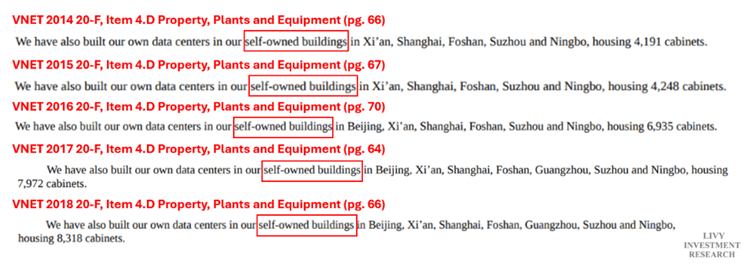
Yet beginning with its 2019 Form 20-F disclosures, the company identified the same 1,200 SQM, 276-cabinet Ningbo High-Tech Zone facility among its leased properties.

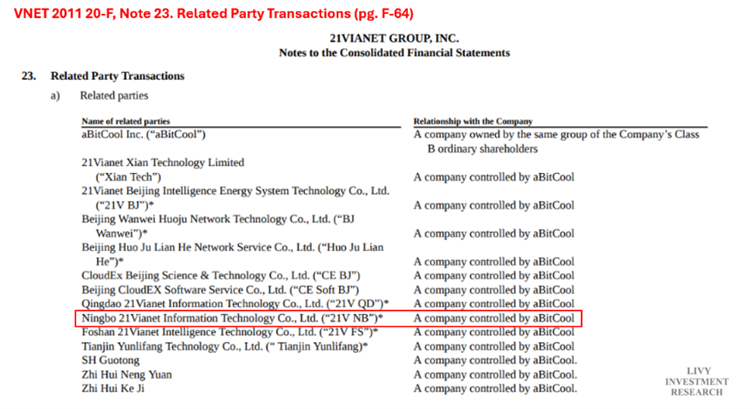
Specifically, the location was subject to an initial ten-year lease term with Ningbo Software and Service Outsourcing Industrial Park Management Service Center expiring on December 31, 2019, before being renewed for another three years through December 31, 2022. The original lease term implies the arrangement had been in place since approximately 2010, but the lessee signing the underlying Ningbo property lease remains unidentified. A plausible candidate is Ningbo 21Vianet Information Technology Co., Ltd. (“21V NB”), which VNET’s 2011 Form 20-F identified as a related party in which it had direct transactions with since 2010.
Continued operation of the data center is corroborated by a 2021 press release by the Chinese Ministry of Science and Technology, which identified the “21Vianet Ningbo National High-Tech Zone Data Center” (世纪互联宁波国家高新区数据中心) as an anchor project within the Ningbo High-Tech Zone. VNET’s 2022 Form 20-F also continued to report exactly 1,200 SQM of leased self-built data center space in Ningbo, with current third-party data center directories still listing a VNET-operated site at the Ningbo High-Tech Zone.
The unexplained discrepancy in the facility’s owned vs. leased classification becomes more significant when viewed alongside the ownership history of 21V NB, VNET’s historical operating relationship with the related party since 2010, and the company’s subsequent 2014 acquisition of the entity.
Reconstructing Ningbo’s Ownership and Reporting Timeline
The ownership discrepancy becomes clear when reconciled against the history of VNET’s Ningbo operations and its associated legal entity, 21V NB, based on the company’s historical SEC filings, financial disclosures and public records:
· 2010 – Ningbo becomes a part of VNET’s data center footprint. Public records show VNET brought data centers in Ningbo, Baoding, Zhengzhou, Huangshi and Huzhou online in January 2010 as part of its distributed IDC deployment strategy (世纪互联 “分布式部署IDC” 战略). This was substantiated by industry news, which separately identified “21Vianet Ningbo” (宁波世纪互联IDC数据中心) as an operator within the Ningbo High-Tech Zone as of 2010. Trinity Research’s September 2014 short-seller report on VNET also identified the Ningbo site at Floor 1, Building D, No. 750 Chuangyuan Road with 276 cabinets, consistent with public records and VNET’s leased data center capacity disclosure in the 2019 20-F.
· 2010-2011 – 21V NB is explicitly identified as a VNET related party. VNET’s 2011 Form 20-F described 21V NB as a company controlled by “aBitCool”, which was owned by the same shareholder group holding VNET’s Class B shares. VNET also disclosed the nature and value of related party transactions with 21V NB, including RMB 149,000 of optical fiber and bandwidth leases from April1-December 31, 2010, with RMB 49,000 of related payables outstanding at year-end, followed by RMB 442,000 of network equipment leases in 2011. The disclosures establish an operational relationship between 21V MB and VNET during the same period in which the Ningbo data center entered into the company’s operating network. However, they do not explain the contractual rights, if any, that allowed VNET to access or recognize the economics associated with the Ningbo facility.
· 2011 – VNET indicates that 21V NB and several other aBitCool-controlled companies were sold to undisclosed third parties. The 2011 Form 20-F related party note disclosure specifically identified 21Vianet Beijing Intelligence Energy System Technology Co., Ltd. (“21V BJ”), Beijing Wanwei Huoju Network Technology Co., Ltd. (“BJ Wanwei”), Beijing Huo Ju Lian He Network Service Co., Ltd. (“Huo Ju Lian He”), Qingdao 21Vianet Information Technology Co., Ltd. (“21V QD”), 21V NB, Foshan 21Vianet Intelligence Technology Co., Ltd. (“21V FS”), and Tianjin Yunlifang Technology Co., Ltd. (“Tianjin Yunlifang”) as aBitCool-controlled entities that have been sold to undisclosed third parties in 2011. As a result, VNET ceased classifying outstanding balances with these entities as related party amounts at year-end.
· 2011-2014 – The Ningbo data center remains associated with VNET’s operating network despite 21V NB’s removal from its related party perimeter. Public records continue to identify the 21Vianet Ningbo National High-Tech Zone Data Center as part of VNET’s distributed IDC presence. This is corroborated by Trinity Research’s September 2014 capacity analysis, which included the Ningbo facility’s 276 cabinets as part of VNET’s data center network. While VNET subsequently rejected Trinity’s broader allegations, neither of its two related public responses (here and here) identified the Ningbo facility as being outside the company’s operating network. This raises an unresolved question over what contractual arrangement(s), if any, allowed VNET to operate the Ningbo data center and/or recognize the facility’s economics while 21V NB remained outside both its consolidation and related party perimeter.
· 2014 – VNET subsequently acquires 21V NB from an undisclosed third-party. VNET’s 2014 Form 20-F aggregates three individually immaterial acquisitions into a single purchase-price allocation disclosure, carrying RMB 64.2 million of total consideration. The disclosure only singles out Guangdong Tianying Information Technology., Co., Ltd. (“GD Tianying”) because its contingent consideration depended on performance targets, but does not separately identify 21V NB. However, audited 2013-2015 disclosures by Tus-Holdings Co., Ltd. (启迪控股股份有限公司 “Tus-Holdings”), which became a controlling shareholder of VNET in 2016, specifically identified 21V NB (宁波世纪互联信息技术有限公司) as a 100%-owned subsidiary within VNET’s consolidated structure. Tus-Holdings’ audited disclosures also identified approximately RMB 20.0 million of goodwill arising from VNET’s acquisition of 21V NB for the year ended December 31, 2014.
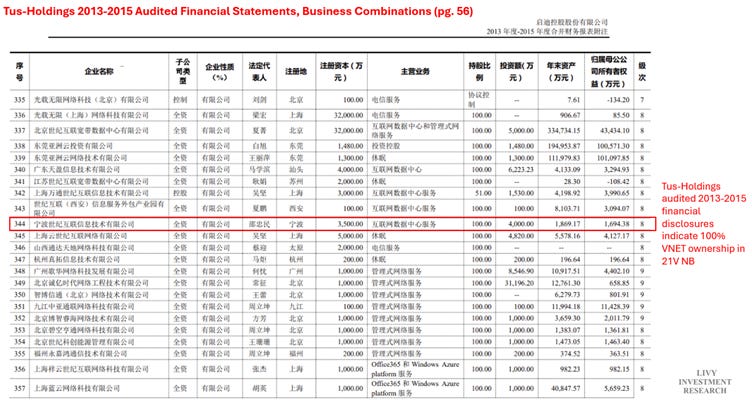
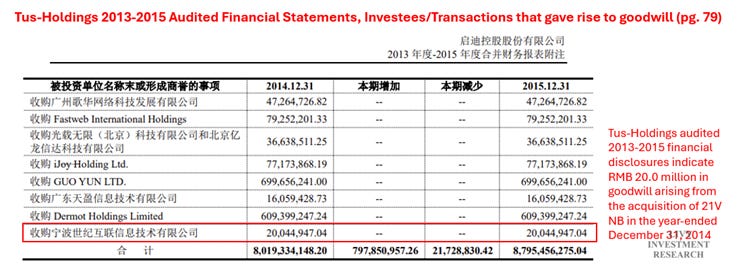
The disclosure effectively substantiates 21V NB’s inclusion among VNET’s 2014 business combinations. The precise acquisition date and identity of the third-party seller remain undisclosed. But when paired with findings in Trinity Research’s September 2014 report, the uncertainty raises skepticism over the timing of 21V NB’s acquisition. Specifically, Trinity Research’s report reproduced Chinese State Administration for Industry and Commerce (“SAIC”) corporate registration records that identified 21V BJ as the owner of 21V NB as of September 2014, implying VNET only acquired the entity later in the year. The sequence of events warrants further scrutiny – especially over whether the transaction only occurred to alter, obscure, and/or conceal the historical ownership and contractual arrangements associated with the Ningbo data center, given the absence of a clear retrospective explanation in VNET’s subsequent disclosures.
· 2014-2018 – Ningbo begins appearing in VNET’s Form 10-K property, plant and equipment disclosure within its “self-owned” building footprint. VNET only began including Ningbo among its self-built data centers housed in “self-owned buildings” under Item 4.D Property, Plants and Equipment disclosures in the 2014 Form 20-F – the same year it acquired 21V NB. The same ownership classification remained in subsequent filings through 2018. Prior to 2014, Ningbo was absent from VNET’s Item 3.D property and capacity footprint disclosures, despite public records indicating that the facility had formed part of its distributed IDC network since 2010. As a result, the Ningbo facility’s first appearance within VNET’s Item 4.D disclosure following the acquisition of 21V NB serves as substantiable evidence that the facility’s underlying property and/or operating rights may have previously resided with 21V NB rather than directly with VNET. The sequence accordingly raises concerns over the effectiveness of VNET’s related party controls, and whether related party transactions and balances were fairly presented and free from material misstatement in its financial reporting.
· 2019 – VNET explicitly identifies the Ningbo property as leased. VNET’s 2019 Form 20-F Item 4.D disclosure states its Ningbo Hight-Tech Zone self-built data center occupied 1,200 SQM of leased, rather than self-owned, space, containing 276 cabinets. The company named the lessor as the Ningbo Software and Service Outsourcing Industrial Park Management Service Center, and stated that the original ten-year lease term expired on December 31, 2019 before renewal for another three years through December 31, 2022. This places the original lease’s commencement at approximately 2010 – the same period in which Ningbo first entered VNET’s publicly disclosed distributed IDC network. However, VNET provided no retrospective explanation reconciling this lease with its 2014-2018 Item 4.D disclosures that had classified Ningbo among data centers housed in “self-owned” buildings. VNET continued to classify the same 1,200 SQM Ningbo facility as a self-built data center housed in leased space through 2022, before collapsing its Item 4.D disclosures into aggregate owned vs. leased floor area rather than identifying individual facilities by geography.
In summary, the reconstructed timeline outlines several key questions that should matter to investors:
1. What contractual rights allowed VNET to operate and/or recognize the economics of the Ningbo data center before its 2014 acquisition of 21V NB? The Ningbo data center has been a part of VNET’s distributed IDC network since 2010 based on public records but was never disclosed as part of its property, plant and equipment and capacity footprint until 2014 after 21V NB’s acquisition. The subsequent change in property disclosures following VNET’s 2014 acquisition of 21V NB provides strong evidence that the Ningbo operation had previously been held under 21V NB. Yet no related party transaction linking VNET to the underlying property or Ningbo-related economics has been identified.
2. What changed economically when 21V NB was removed from VNET’s related party perimeter in 2011? VNET disclosed that 21V NB had been sold to an undisclosed third party in 2011, but the Ningbo data center continued to form part of its operating network. Meanwhile, the contractual relationship governing VNET’s access to the facility and exposure to related economics, if any, remained unclear.
3. Who did VNET acquire 21V NB from in 2014, and when did the acquisition occur? Information regarding the third-party seller and transaction date remain undisclosed, while SAIC records reproduced by Trinity Research identified 21V BJ as 21V NB’s owner as of September 2014. The transaction’s coincidental timing further raises skepticism over whether the acquisition could have obscured the financial reporting of VNET’s historical ownership and related party transactions surrounding the Ningbo facility.
4. Why did Ningbo only start to appear in VNET’s Item 4.D property disclosures following the acquisition of 21V NB when public records show the facility has been in its operating network since 2010? And why was it classified among data centers housed in “self-owned” buildings? VNET later disclosed beginning in 2019 that the same Ningbo data center occupied leased premises under a ten-year contract dating back to approximately 2010.
5. Why was the 2014-2018 ownership classification of the building housing the Ningbo data center never retrospectively reconciled after VNET subsequently identified the property as leased in 2019? The absent explanation raises broader concerns over the effectiveness of VNET’s controls surrounding related parties and property rights, as well as the completeness and accuracy of associated financial reporting.
21V Xi’an Shows What VNET Could Have Disclosed
Taken together, the Ningbo discrepancy raises more than a historical property rights classification issue. VNET’s financial reporting treatment of another former aBitCool-controlled data center in Xi’an provides a useful comparison.
Before VNET acquired 21V Xi’an in 2012, the company explicitly disclosed related party transactions with the entity from 2009 through 2011 in its Form 20-F filings – including amounts attributable to services, equipment rentals and purchases, and leases of optical fiber and bandwidth. These transactions were very much similar in nature to those disclosed with 21V NB before its consolidation into VNET in 2014. However, for transactions associated with 21V Xi’an, VNET also disclosed specific agreements between the entity and 21Vianet (Xi’an) Information Outsourcing Industry Park Services Co., Ltd., a consolidated VIE – including an equipment and cabinet lease dated April 14, 2010, a sale and purchase agreement dated November 24, 2010, and an energy and technology services agreement dated December 1, 2010.
This is consistent with VNET’s subsequent acquisition disclosure in the 2012 20-F , which states “21V Xi’an had previously sold cabinets and leased data center space to the company”. VNET further explained that the acquisition of 21V Xi’an in 2012 was intended to “expand the Company’s self-built data center and increase the number of cabinets”, allowing it to “effectively manage market demand and improve profit margins”.
However, no comparable disclosure has been identified for 21V NB, despite the Ningbo data center forming a core component of VNET’s distributed IDC network since 2010. The company’s SEC filings do not identify any equivalent agreements explaining how VNET accessed or operated the Ningbo facility, which entity bore the underlying operating costs, or how the associated economics flowed into VNET’s financial statements.
Meanwhile, materiality doesn’t provide a substantiable explanation for the difference in disclosure transparency between the two acquisitions. VNET paid approximately RMB 16.0 million to acquire 21V Xi’an in 2012, yet still provided detailed disclosures of the pre-acquisition related party arrangements. By comparison, VNET’s acquisition of 21V NB in 2014 generated approximately RMB 20.0 million of goodwill alone, exceeding the purchase consideration paid for 21V Xi’an. This suggests 21V NB was at least comparable in financial significance to 21V Xi’an, if not more material, from both an operating and transaction value standpoint.
As a result, the contrast demands scrutiny over why VNET provided substantially greater transparency into the contractual and economic relationship surrounding Xi’an than Ningbo – especially when compounded by the subsequent property classification discrepancies associated with the latter facility.
Potential Financial Reporting Implications
More importantly, the property disclosure discrepancy related to Ningbo prevents investors from determining whether the issue is limited to an isolated error in describing the underlying building as owned vs. leased, or extends more broadly into VNET’s financial reporting. Here are some potential accounting implications to consider if the discrepancy in the Ningbo property classification did extend beyond disclosure presentation:
For the period before VNET acquired 21V NB in 2014, if VNET recognized revenue or other economics associated with the Ningbo facility while building rent and other operating costs remained with the unconsolidated entity, then reported profitability and EBITDA could have been overstated. If VNET’s related party relationship with 21V NB also gave it power to direct the Ningbo operation while retaining significant economic benefits, then the arrangement could also raise a separate question over whether VNET effectively controlled 21V NB and should have consolidated the entity under ASC 810, Consolidation considerations.
The potential financial reporting implications also extend beyond the pre-acquisition period. If VNET’s 2014-2018 classification of Ningbo as housed in a “self-owned” building extended into the underlying accounting treatment rather than being limited to a disclosure error, the discrepancy could have overstated PP&E and depreciation costs, while understating operating lease expense. Under lease accounting rules applicable at the time (formerly, ASC 840), incorrectly capitalizing an operating lease would also have shifted rent expense into depreciation, which is excluded from EBITDA. This potentially overstates a critical metric used by stakeholders to assess VNET’s operating performance, financial health and leverage.
The potential impact is especially consequential when viewed against VNET’s capital-intensive investment cycle as it entered its aggressive expansion into purpose-built wholesale data centers starting 2019. Specifically, capex attributable to the purchase of PP&E surged from RMB 435.2 million in 2018 to RMB 1.25 billion in 2019 and RMB 2.47 billion in 2020, increasing multi-fold from 12.8% of revenue to 33.0% and 51.2%, respectively.
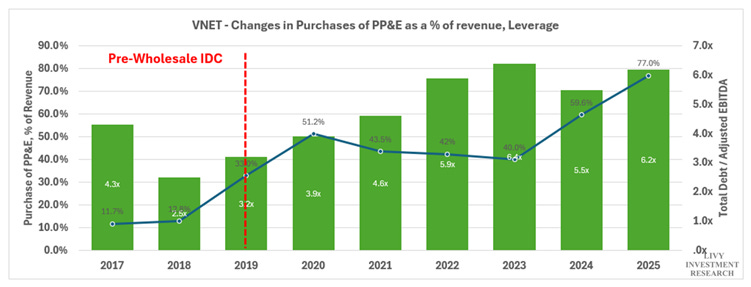
Meanwhile, its outstanding borrowings and finance-lease obligations also consistently increased over the same period, heightening the importance of reliable and accurate EBITDA and related leverage metrics as VNET became incrementally dependent on external capital to fund growth investments at the time.
A Broader Disclosure Control Weakness
Taken together, the absence of underlying Ningbo contracts and a clear reconciliation of the facility’s revenues, costs, property rights and related obligations limits investors from determining whether the issues identified were isolated to a multi-year property disclosure error or reflected broader weaknesses in financial reporting controls. And from my audit experience, the persistence of the discrepancy is particularly difficult to overlook.
While the external audit opinion doesn’t extend to Item 4.D, the annual Form 20-F filing would have usually required multiple layers of management, finance and legal review before submission to the SEC. Under Exchange Act Rule 13a-15 and the COSO framework, VNET should have also maintained and regularly evaluated effectiveness of disclosure controls and procedures specifically designed to ensure information required in its SEC filings are accurate, reliable and complete. As a result, the repeated “self-owned” classification of VNET’s Ningbo facility from 2014 through 2018, followed by the absence of any retrospective reconciliation after the building was identified as leased beginning 2019, raises questions over the operating effectiveness of relevant disclosure controls, and whether the underlying issue carried broader financial reporting implications.
Part II – A Multi-Year Property Rights Gap
The second finding concerns VNET’s prolonged inability to obtain property ownership and land use right certificates for certain buildings used for operating its data centers.
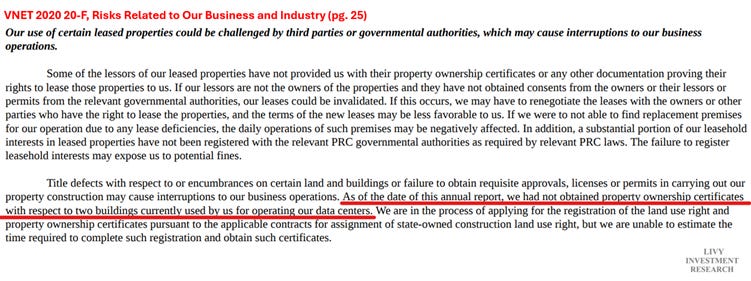
Beginning with its 2020 Form 20-F, VNET disclosed it is missing property ownership certificates with respect to two buildings already being used for operating its data centers. The company identified this as a risk related to its business, citing ongoing efforts to register the related “land use right and property ownership certificates pursuant to the applicable contracts for assignment of state-owned construction land use right”, but could not estimate when the process would be completed.
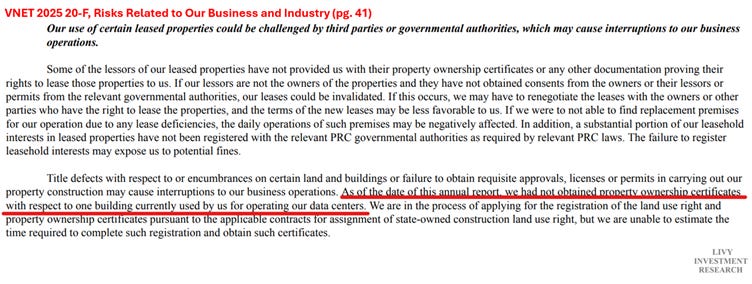
The same risk disclosure persisted into 2025, when VNET reduced the number of affected buildings from two to one. However, management provided no explanation to which facility was removed from the risk disclosure, and whether the required certificates have been obtained. The company also continued to state that it could not estimate when registration for the remaining building would be complete.
Deviation from the PRC Real-Estate Registration Process
The extended duration of the outstanding issue represents a significant deviation from processing times outlined under the PRC Ministry of Justice’s Interim Regulation on Real Estate Registration (不动产登记暂行条例). Article 20 specifically requires real estate title registration to be completed within 30 working days after a valid application is formally accepted by the registration authority, unless otherwise provided by law.
As a result, VNET’s inability to secure the related land use right and property ownership certificates for a data center already in operation for more than five years raises questions over the nature and severity of underlying documentation and/or compliance deficiencies preventing completion of the registration process.
More importantly, VNET provides limited detail on the capacity, asset carrying value, and earnings contributions related to the affected data center. The company also did not explain how the property ownership registration issue affecting one of the two previously identified data centers was resolved in 2025 – including the nature of compliance deficiencies that had previously hindered the process and what changed to complete the registration process. This collectively limits investors’ visibility into the economic significance of VNET’s exposure if the unresolved property rights ultimately disrupt operations or impair value of the associated assets.
Quality and Recoverability of Associated PP&E At Risk
The unresolved property ownership registration issue potentially weakens the durability of economics associated with the affected data center. The value of related infrastructure recorded within VNET’s PP&E balance depends not only on the physical asset’s existence, but also on the company’s ownership rights to the land and buildings supporting operations.
Specifically, U.S. GAAP defines an asset as “a present right of an entity to an economic benefit”. From a financial reporting perspective, VNET’s prolonged inability to obtain the relevant property ownership and land use right certificates for the affected data center raises a particular challenge to the rights and obligations assertion supporting the associated PP&E. While VNET may hold other contractual rights supporting recognition of the related infrastructure, the missing ownership certificates effectively introduce uncertainty over the legal enforceability of interests underpinning assets already in use to generate economic benefits.
The uncertainty could also impact subsequent recoverability assessments under ASC 360, Property, Plant and Equipment, which requires long-lived assets to be tested for impairment when events occur that indicate their carrying amounts may no longer be recoverable. The recoverability assessment compares the carrying value of the relevant asset group (e.g., data centers) against the undiscounted cash flows expected from its continued use and eventual disposition (i.e., over its economic useful life). If the relevant asset group exceeds the undiscounted cash flows expected over its remaining useful life, then an impairment loss is recognized based on the difference to write the carrying value of PP&E down to fair value. A prolonged property rights issue could increase the risk of operational disruption, restrict future use of the affected data center, and/or reduce its disposition value, potentially impacting the anticipated cash flows and recoverability of the associated PP&E.
The risk becomes especially relevant as VNET invests aggressively in expanding its data center portfolio and capture accelerating AI infrastructure demand. If the underlying legal rights supporting an operating facility are weak, then the economic quality of the associated PP&E and durability of its future cash flows could also underperform what headline carrying value implies. The same uncertainty could also affect VNET’s collateral quality and financing access as it becomes increasingly reliant on external capital to fund capacity expansion.
More importantly, the fact that VNET’s prolonged property rights registration issue hasn’t resulted in material business disruption doesn’t diminish or eliminate the underlying risk. The absence of consequences to date may instead have caused some investors to underappreciate the potential magnitude of VNET’s exposure to an unresolved operating risks that remains difficult to quantify. Until VNET identifies the affected facility, explains the compliance or documentation deficiencies preventing registration, and quantifies the related capacity, asset carrying value and earnings contribution, the associated downside risk remains difficult to assess.
Part III – Unverified Landlord Rights Raise Site-Level Control Risks
Similar to the first two findings, the third also raises concerns over potential deficiencies in VNET’s property rights controls – this time involving leased facilities where certain lessors have yet to provide sufficient evidence substantiating ownership or legal authority to rent out the associated properties.
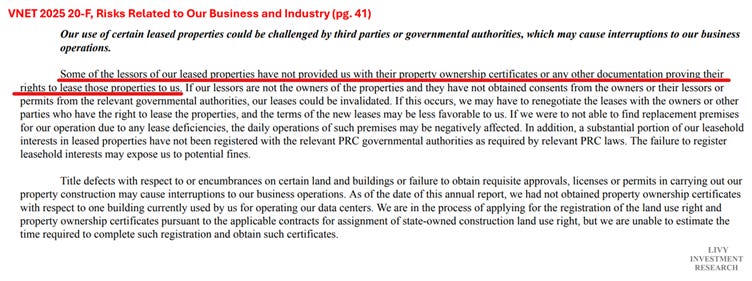
VNET’s 2025 Form 20-F continues to acknowledge that some lessors of its leased facilities have yet to provide property ownership certificates or other documentation proving their right to rent out those locations to the company. The business risk has persisted since 2020, with management further cautioning that the underlying leases of affected offices, data centers or other operating facilities could be invalidated. Under such circumstances, VNET may be required to renegotiate with the legitimate counterparty holding relevant property rights, face potentially less favourable terms or find replacement premises, which could adversely affect its operations.
VNET has also acknowledged that a substantial portion of its leasehold interests have not been registered with relevant PRC authorities as required by law. While similar registration deficiencies are disclosed by industry peers like GDS Holdings Ltd, their coexistence with VNET’s broader unresolved property rights issues warrants additional scrutiny around the effectiveness of controls governing the completeness and accuracy of its PP&E portfolio.
The risk disclosure is especially relevant, given a material portion of VNET’s self-built data center footprint is located on leased properties, and requires significant capital commitment towards relevant infrastructure – spanning networking, cooling systems, cabinets and other equipment. As of December 31, 2025, VNET reported 421,185 SQM of total self-built data center floor area housed within leased facilities. On this premise, the company’s inability to fully verify certain lessors’ ownership or legal authority to lease the underlying properties raises material concerns over the durability of VNET’s rights to operate from those locations and the recoverability of relevant capital commitments already deployed.
Site-Level Due Diligence In Question
The central concern is what gives management sufficient comfort in deploying significant capital, customer workloads and critical operating infrastructure to a leased property before fully establishing the relevant counterparty’s legal rights to lease it.
The issue is especially relevant given VNET’s accelerating expansion of its purpose-built wholesale platform. Specifically, VNET’s latest Form 20-F states that its wholesale IDC business sources sites by “acquiring or leasing green-field sites or existing industrial buildings from third parties” before designing and constructing the facilities according to customers’ technical specifications.
This directly exposes a portion of its wholesale footprint to leased property risk, with the purpose-built nature of these highly customized facilities concentrating capital commitments and customer obligations at individual sites. VNET currently hosts wholesale contracts with terms ranging from eight to ten years, with 95.3% of capacity in service already committed as of December 31, 2025. By comparison, VNET’s retail IDC business is much more modular, with service offered to a much broader customer base that typically operate under contract terms ranging from one to three years.
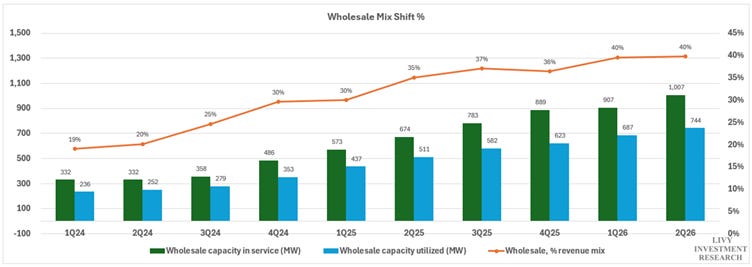
Considering the accelerating revenue and capacity mix shift towards its longer-duration, customer-concentrated wholesale IDC business, VNET faces a heightened economic risk exposure if an underlying lease is challenged. The company’s limited transparency over the bifurcation of leased vs. owned wholesale capacity also adds an incremental layer of uncertainty, further increasing difficulty in quantifying the overall risk exposure.
Challenged verification of certain lessors’ ownership or legal authority also raises questions over the design and operating effectiveness of VNET’s site selection and property due diligence controls. Specifically, VNET’s governance disclosures identify oversight of internal controls and risk management as part of the Board’s responsibilities. Its Audit Committee Charter also separately requires regularly review of “the adequacy and effectiveness of the company’s accounting and internal control over financial reporting, [and] disclosure controls”, while also providing oversight of legal and regulatory matters that could materially affect the company’s financial statements. VNET’s Code of Business Conduct and Ethics further requires employees to comply with applicable laws and refrain from inaccurate or incomplete financial reporting.
Based on the stated governance responsibilities, the persistent lack of lessor rights verification and failure to comply with PRC lease registration requirements warrant scrutiny over the effectiveness of VNET’s relevant entity-level controls. Relevant deficiencies could heighten the company’s legal, operational and economic risk exposure through affected properties, weakening confidence in the completeness, accuracy and reliability of related financial reporting.
The uncertainty also extends into VNET’s potential loss exposure if an affected lease is challenged and requires renegotiation or relocation. The financial impact could extend well beyond the carrying value of infrastructure already installed at the affected property and spill into customer contracts, supplier commitments and incremental relocation costs. Depending on the contractual obligations associated with an affected site, operational disruption could also expose VNET to material customer disputes, receivables collectability risk, fines and/or churn.
Taken together, VNET’s operating footprint remains exposed to defective lease rights. And the materiality of relevant economic implications remain difficult to assess given limited transparency into the affected facilities, related capital commitments and earnings contributions. The issue accordingly introduces an incremental layer of uncertainty around the quality of property rights supporting VNET’s reported capacity. As the company accelerates capital commitments towards AI infrastructure capacity expansion, persistent weaknesses in site selection and property due diligence increases the risk of onerous investments, incremental cost headwinds and less predictable returns, threatening visibility into the durability of VNET’s prospective ROI trajectory.
Why the Three Findings Matter Together
Individually, each of the three findings could be explained as an isolated property disclosure issue. But when viewed together, they underscore a recurring pattern of deficiencies around the classification, verification and legal rights underpinning VNET’s expanding operating capacity.
The Ningbo discrepancy raises unresolved questions over historical ownership and related party accounting. Meanwhile, the prolonged gap in property ownership registration for certain data centers heightens uncertainty around the enforceability and recoverability of VNET’s assets already in operation. This is further compounded by incomplete verification of certain lessors’ rights, calling into question the effectiveness of site-level due diligence governing the existence, completeness, rights and obligations, and accuracy of related property and lease arrangements.
The outstanding issues are especially concerning as VNET accelerates capacity expansion to capitalize on emerging AI infrastructure demand. Greater capital commitments, when coupled with persistent weaknesses in property rights, are increasing VNET’s exposure to onerous investments, operational disruption and incremental financing requirements. Yet limited transparency into the affected facilities, related asset values and earnings contributions makes the economic significance of related risks increasingly challenging for investors to quantify.
Taken together, the central issue facing VNET is not in its ability to capture accelerating AI demand, but rather the tangibility of underlying property rights critical to sustaining relevant economic returns. Until management provides greater transparency around the unresolved property rights concerns and their potential financial reporting implications, the uncertainty warrants a higher risk premium than VNET’s current AI growth narrative implies.
The Risk Discount Remains Insufficient
I initially disclosed VNET in my short book on August 27, when the ADS closed at $6.64. The stock has since declined about 43% to $3.77 as of October 27. Despite the magnitude of VNET’s recent correction, the stock has yet to re-rate to a level that adequately compensates investors for the asymmetric downside risks associated with its unresolved property rights and reporting deficiencies.
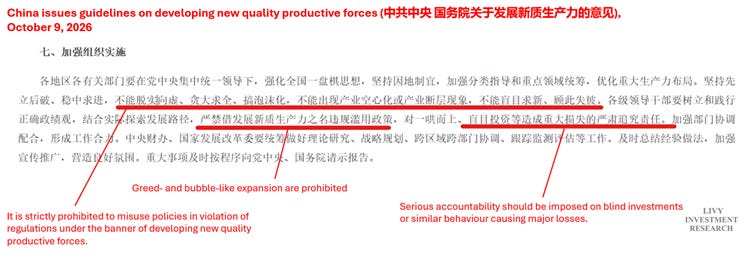
This is further amplified by China’s tightening regulatory backdrop. While the central government continues to encourage AI self-sufficiency through favourable policy and generous financial support, recent regulatory guidance has warned against excessive, bubble-like expansion and blind investment in emerging technologies.
Specifically, the Communist Party of China Central Committee and the State Council introduced 19 new measures on “developing new quality productive forces”. The guidelines demand stronger oversight of AI developments, while also calling for greater accountability for planned technology projects – directly exposing VNET’s unresolved property rights and relevant control weaknesses to greater regulatory scrutiny as its capacity buildout accelerates.
Given persistent uncertainties over the reliability of VNET’s financial reporting and fundamental outlook, a relative valuation framework based on comparable peer multiples is more appropriate than a traditional DCF in gauging the company’s intrinsic value. Against this backdrop, I value VNET against comparable peers such as GDS Holdings using forward adjusted EBITDA, while applying an incremental discount to reflect company-specific vulnerabilities in property rights, financial reporting control and disclosure risks.
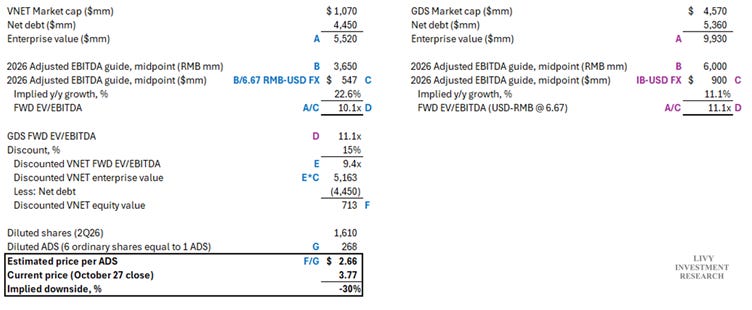
At $3.77 per ADS – or $1.07 billion market cap – VNET carries an enterprise value of about $5.52 billion. Considering the midpoint of management’s RMB 3.55 billion to RMB 3.75 billion 2026 adjusted EBITDA guidance, which implies about 22.6% y/y growth, the stock trades at roughly 10.1x forward EBITDA. GDS Holdings, by comparison, carries an enterprise value of approximately $9.93 billion, implying a valuation of about 11.0x against 11.1% y/y growth at the midpoint of its RMB 5.9 billion to RMB 6.1 billion 2026 adjusted EBITDA outlook.
While this already reflects an 8% discount to GDS Holdings despite VNET delivering materially stronger EBITDA growth, the valuation gap doesn’t yet adequately capture the incremental weaknesses in its underlying property rights, which could materially undermine the reliability of prospective cash flows. The company-specific risks should warrant a structurally wider discount to GDS Holdings’ forward multiple.
Applying a 15% discount to GDS Holdings’ 11.0x forward adjusted EBITDA multiple would imply a valuation of about 9.4x for VNET. This better reflects the company’s risk-adjusted profile given its greater capital intensity, leverage and additional exposure to unresolved property rights and related financial reporting risks. The discounted multiple applied translates to an estimated equity value of about $2.66 per ADS, representing another 30% downside from current levels.
The discount applied is also consistent with historical valuation compression observed across Chinese big tech during recent periods of heightened regulatory scrutiny. In the tranches of the 2021-2022 Chinese technology crackdown, Alibaba’s forward EV/EBTIDA compressed towards mid-single-digits, despite carrying a substantially stronger balance sheet than VNET today. As of March 31, 2022, Alibaba held RMB 446.4 billion of cash and short-term investments against approximately RMB 141.3 billion of bank borrowings and unsecured senior notes, reflecting a significant net cash position. Meanwhile, VNET carried RMB 23.4 billion of short- and long-term debt against RMB 7.2 billion of cash, restricted cash and short-term investments as of June 30, 2026. Its substantially greater leverage and capital intensity reflect an equity profile that’s much more vulnerable to multiple compression if confidence in the durability of prospective returns deteriorates further.
The sensitivity is heightened as China intensifies its oversight of AI infrastructure expansion. Greater regulatory scrutiny on project quality and capital discipline could increase the significance of VNET’s company-specific weaknesses – especially as the company accelerates capacity expansion, while uncertainty over the underlying property ownership and lease rights supporting its data center footprint remain unresolved. If regulatory oversight increasingly shifts from infrastructure capacity expansion towards the legal, operational and economic quality of underlying projects, VNET’s unresolved property rights exposure could invite a structurally higher risk premium.